


5 Ways to Humanize Your Content in the Era of AI

Let's be honest for a second. You've probably read three articles today that sounded... off. Grammatically perfect, polished structure, and all the right keywords. Yet, by the time you closed the tab, you couldn't remember a single thing they said.
That's the reality of AI-generated content. While AI is a powerful tool for brainstorming, research, and speeding up the writing process, it can't replace one thing: real human experience.
Your audience doesn't just want information; they want authenticity. And that's exactly what Google's E-E-A-T (Experience, Expertise, Authoritativeness, and Trustworthiness) framework rewards.
If you want your content to connect with readers and rank well in search results, you need to write like someone who's lived the experience, not just summarized it.
Human Written vs. AI Written Content: What's the Difference?
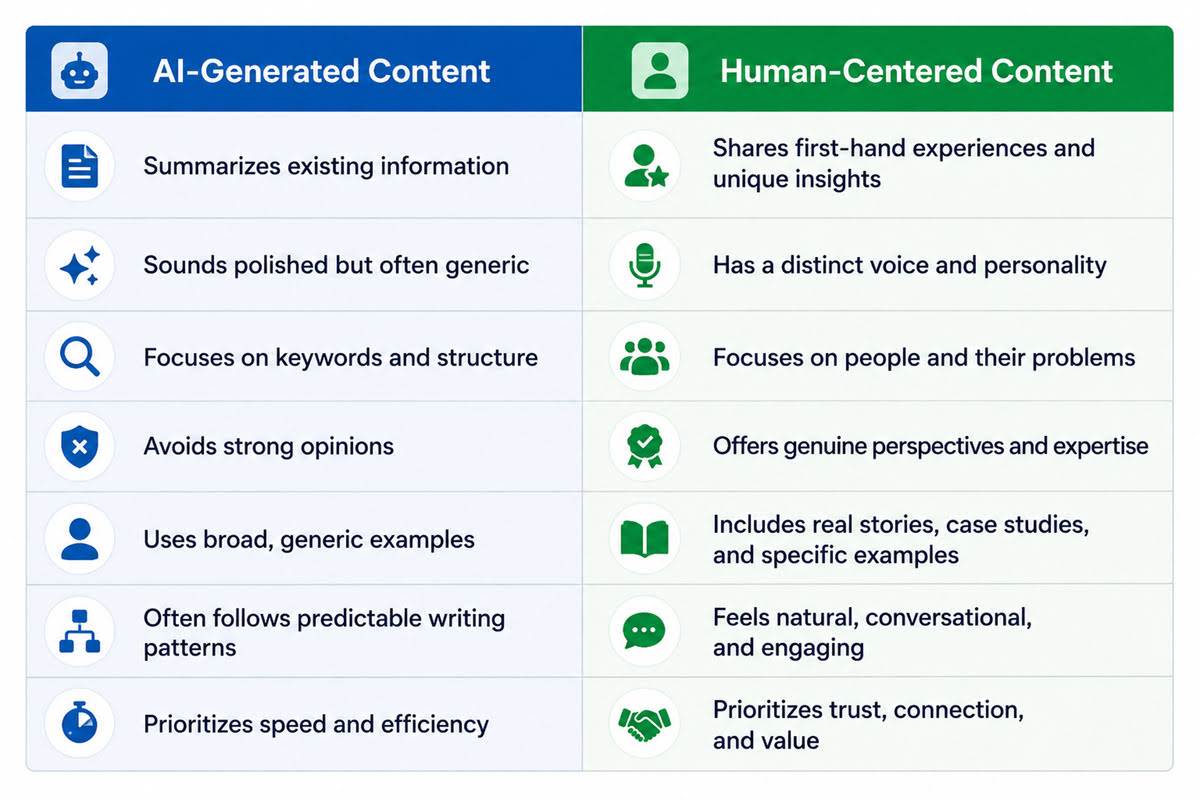
Before we dig in, let's quickly look at how AI-generated content and human-written content actually differ:
The good news?
You don't have to choose between AI and human writing. The best content uses AI to speed up research and drafting, while a human adds experience, personality, and insight.
According to HubSpot's 2025 State of AI report, only 7% of marketers publish AI-generated content without editing, while 56% rewrite AI drafts before they go live. This shows that successful brands still rely on human expertise to add context, experience, and originality.
Likewise, HubSpot and SurveyMonkey found that only 30% of consumers trust AI-generated content, highlighting why authentic, experience-driven writing matters more than ever.
So, How Do You Humanize Your Content?
The good news is that you don’t need to stop using AI.
You simply need to add the elements that only humans can bring. In fact, Google's AI Overviews are changing how users consume search results, making original insights and semantic SEO more important than ever.
Here are five practical ways to do exactly that.

1. Write Like You're Talking to One Person
The biggest mistake brands make is writing for "everyone." When you write for everyone, you write for no one. Your reader isn't a demographic segment; they're one person, sitting somewhere, scrolling on their phone, wondering if you actually get their problem.
Try this: instead of writing "Many small business owners struggle with cash flow," write "You know that feeling when payroll is due Friday, and half your invoices are still unpaid? Yeah, we've been there too."
See the difference? One sounds like a report. The other sounds like a friend who's been through it.
This customer-centric approach naturally leads to conversational writing, making your content more engaging and easier for readers to trust.
Example:
Great content starts with a customer-centric approach.
Instead of saying, "People like fast food delivery," Foodpanda's campaigns often speak directly to a busy office worker or student with messages like, "Long day at work? Let us handle dinner tonight." The copy feels like a conversation with one person, making it far more relatable than a generic marketing statement.
When you write for one person, your tone naturally becomes warmer, your sentences shorter, and your message clearer. That's the E-E-A-T "Experience" pillar in action.

2. Include First-Hand Examples
AI can generate information. It cannot generate a story that actually happened to you. This is your biggest, most underused advantage.
First-hand experiences also strengthen your topical authority, demonstrating to both readers and search engines that your advice comes from practical knowledge rather than recycled information.
If you're writing about productivity, don't just say "time-blocking improves focus." Say: "I tried time-blocking for two weeks and honestly hated it at first, until day nine, when I finished a project three days early for the first time in months."
Real specifics: dates, numbers, small failures, unexpected results are things AI simply cannot fabricate convincingly. They're proof you've actually done the thing you're writing about.
HubSpot does this brilliantly in its marketing blog. Instead of generic advice, they often share internal campaign data, screenshots of what worked (and what flopped), and real numbers from their own funnels. Combined with brand storytelling, this transparency builds the "Experience" and "Trustworthiness" that Google and readers are actively looking for.
Example:
During campaigns like 11.11 and Black Friday, Daraz often highlights seller success stories, customer reviews, and shopping insights instead of focusing only on discounts. These real-life stories make the content more credible because readers can see actual experiences rather than generic marketing claims.
Even a single line like "when we tested this with our own newsletter, open rates jumped 12%" does more for your credibility than ten paragraphs of generic tips.
3. Identify the Hallmarks of AI-Generated Content
To sound human, you first need to recognize what "robotic" actually sounds like.
After reviewing and editing AI-generated content for clients across different industries, we've noticed one recurring pattern: the AI algorithm often repeats the same idea in multiple ways without adding new value. During editing, we remove these repetitions and replace them with specific examples or original insights, making the content more concise, engaging, and useful for readers.
Some dead giveaways:
- Overuse of words like "delve," "moreover," "furthermore," and "in today's fast-paced world"
- Perfectly balanced paragraphs with no personality or rhythm variation
- Saying the same thing in three different ways.
- Vague, safe statements that never take a real stance
- Lists that sound like they were generated to hit a word count, not to help anyone
- An absence of humor, sarcasm, or opinion
Once you spot these patterns, you can actively edit them out. Read your content out loud. If it sounds like something a customer service bot would say, rewrite it. Use contractions. Disagree with something occasionally. Throw in a joke that might not land for everyone, because content that tries to please everyone pleases no one.
4. Add Emotion, Because People Remember Feelings
Here's a fact that never gets old: people forget what you said, but they remember how you made them feel. Data convinces the brain, but emotion moves the hand toward the "buy" or "subscribe" button.
This doesn't mean manufacturing fake drama. It means being honest about the frustration, excitement, relief, or even mild embarrassment behind your topic. If you're writing about a fitness journey, don't just say "consistency is key." Say: "I quit four times before it finally stuck, and honestly, quitting felt like relief every single time, until it didn't."
Nike's "Just Do It" campaigns rarely talk about shoe technology first. They talk about doubt, failure, and the emotional grind before the win. That's why the brand feels human despite being a massive global corporation.
5. Back Your Ideas with Relevant Statistics
A strong AI content strategy doesn't rely on data alone. A well-placed, specific statistic acts like a nod from a credible expert standing next to you.
Instead of a vague claim like "video content performs better," say: "According to HubSpot's 2024 marketing report, video content generates 66% more qualified leads per year than static content." Numbers with sources attached signal Authoritativeness, one of the four pillars of E-E-A-T, and they show readers you didn't just guess; you checked.
But don't drown your writing in stats either. One or two well-chosen numbers per section is plenty. Anything more and you're back to sounding like a spreadsheet.
To learn more about Google's E-E-A-T framework and how it influences search rankings, read our blog: Google EEAT and Its Impact on SEO.
Tools That Can Help You Humanize Your Content
AI can get you 80% of the way there; these tools help close the gap so the final 20% actually sounds like you.
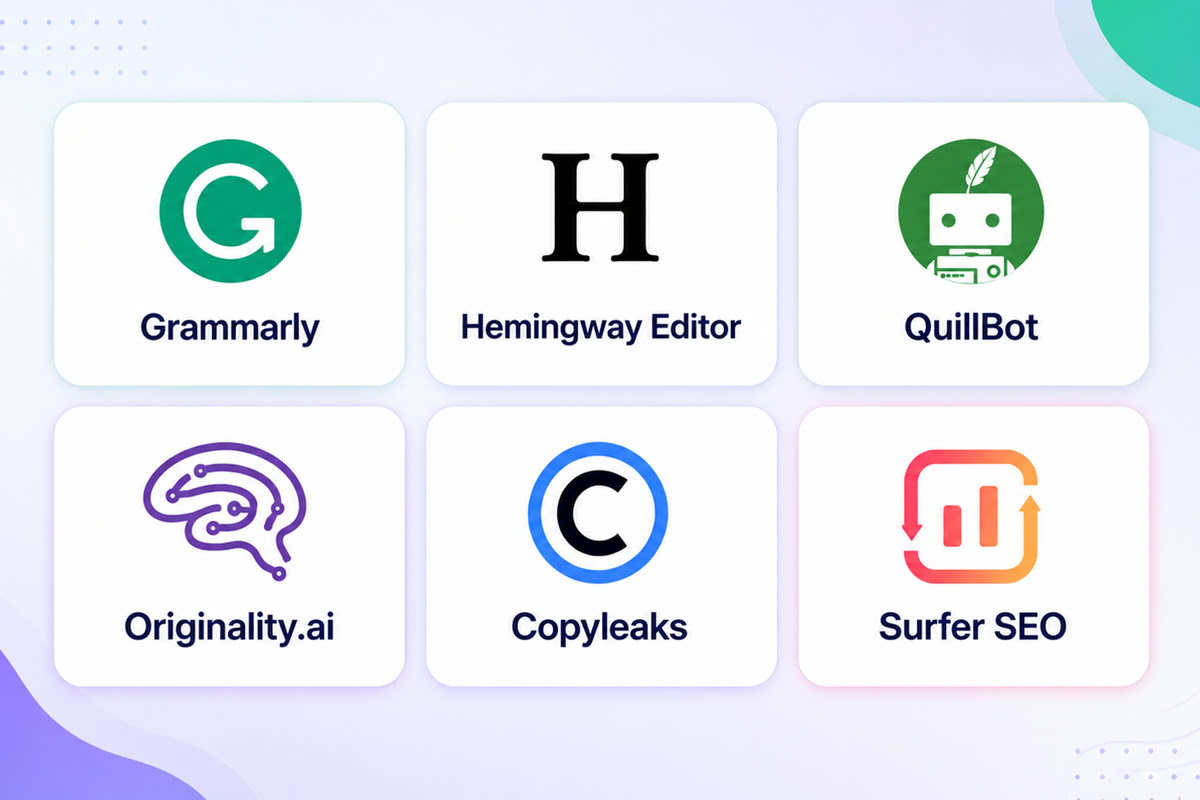
- Grammarly: Beyond grammar checks, its tone detector flags when your writing sounds stiff, robotic, or overly formal, so you can loosen it up before hitting publish.
- Hemingway Editor: Highlights overly complex sentences and passive voice, pushing you toward the short, punchy phrasing real humans actually use.
- QuillBot: Useful for rephrasing AI-drafted paragraphs into something with more natural rhythm and varied sentence length.
- Originality.ai: Checks your content for AI-detection scores, so you know exactly how "machine-like" it still reads before your audience does.
- Copyleaks: Similar to Originality.ai, often used alongside plagiarism checks to make sure your "humanized" version isn't just reworded AI text.
- Surfer SEO: Helps balance E-E-A-T and keyword optimization together, so you're not sacrificing personality for SEO score.
A quick rule of thumb: use these tools to polish your human draft, not to generate it. Detection and rewriting tools work best as a final filter, not a starting point.
Common Mistakes That Make Content Sound AI-Generated
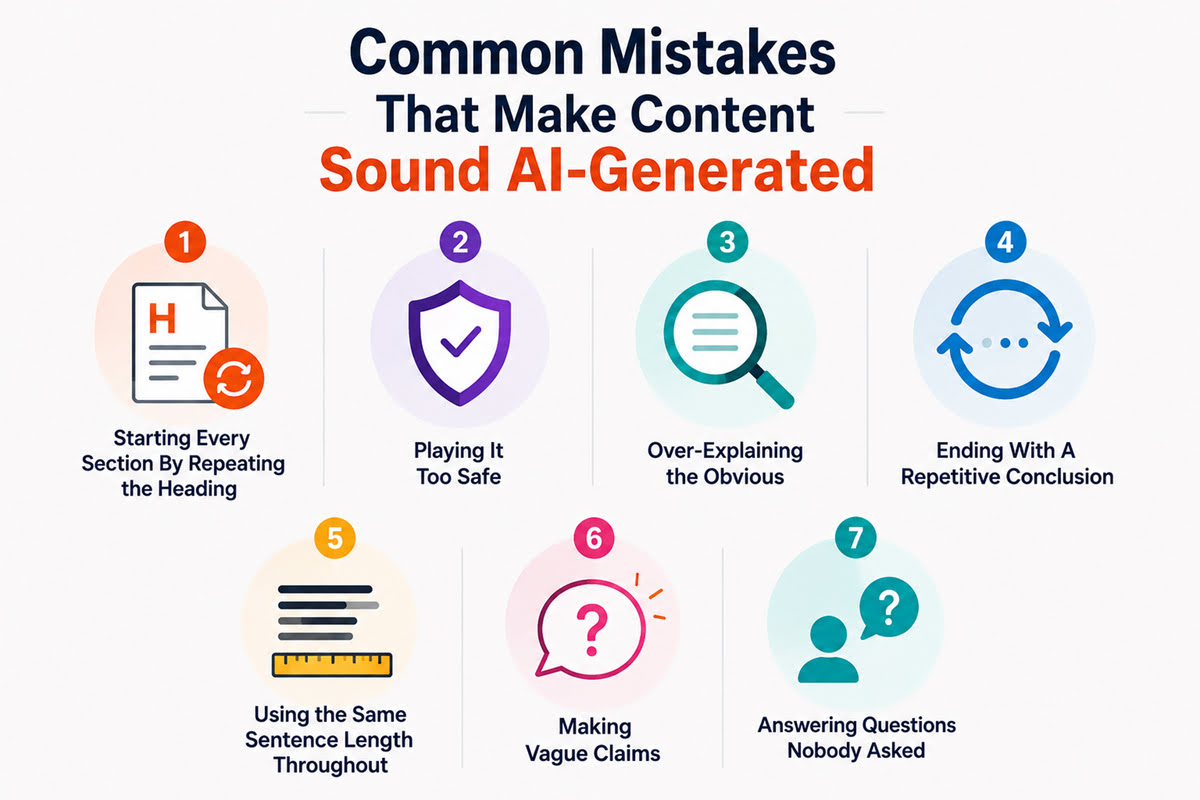
Even experienced writers can fall into these habits, especially if they've been relying on AI tools for a while. Over time, it's easy to start copying AI's writing patterns without even realizing it.
Here are some of the biggest red flags to watch out for:
Starting Every Section By Repeating the Heading
Instead of jumping straight into the point, AI often restates the heading. For example: "When it comes to time management, time management is important because..." Human writing gets to the value immediately.
Playing It Too Safe
Phrases like "it could be argued that," "in many cases," or "some people believe" make your writing sound uncertain. If you have experience with the topic, don't be afraid to take a clear stance.
Over-Explaining the Obvious
AI loves defining terms nobody asked about. If you're writing for marketers, you don't need to explain what SEO or a CTA is. Know your audience and write at their level.
Ending With A Repetitive Conclusion
If your conclusion simply says, "In conclusion, as we've discussed..." you're not adding value. Use the ending to leave readers with a fresh insight, a practical takeaway, or a question to think about.
Using the Same Sentence Length Throughout
AI often writes in a predictable rhythm. Mix short, punchy sentences with longer ones to make your writing feel more natural and engaging.
Making Vague Claims
"Many companies have seen success with..." vs. "When Airbnb tested this in 2019...", vague claims are an AI fingerprint.
Answering Questions Nobody Asked
AI often adds unnecessary explanations just to increase word count. Strong human writing stays focused on solving the reader's problem.
A Simple Editing Tip
Before you publish, read your article from your reader's perspective, not your writer's.
If you can predict the next sentence before you read it, chances are your content has become too generic. Add a personal insight, a stronger opinion, or a real-world example to make it feel like something only you could have written.
Our Experience Humanizing AI Content
At Artx Pro, we've found that AI drafts often provide a solid starting point but rarely capture the client's expertise or brand voice. As a leading digital marketing agency in Pakistan, we've learned that while many businesses follow the latest trends in AI content creation, lasting results come from combining AI with human expertise, original insights, and authentic brand voice.
One SaaS client came to us with 25 AI-generated blog posts that were technically correct but averaged less than a minute of engagement time. After rewriting them with expert commentary, customer examples, and original insights, average time on page increased by 38% over the next three months.
Before You Hit Publish, Ask Yourself:
Before you click the Publish button, take a minute to review your content. This quick checklist can help you ensure your writing feels authentic, valuable, and genuinely human.
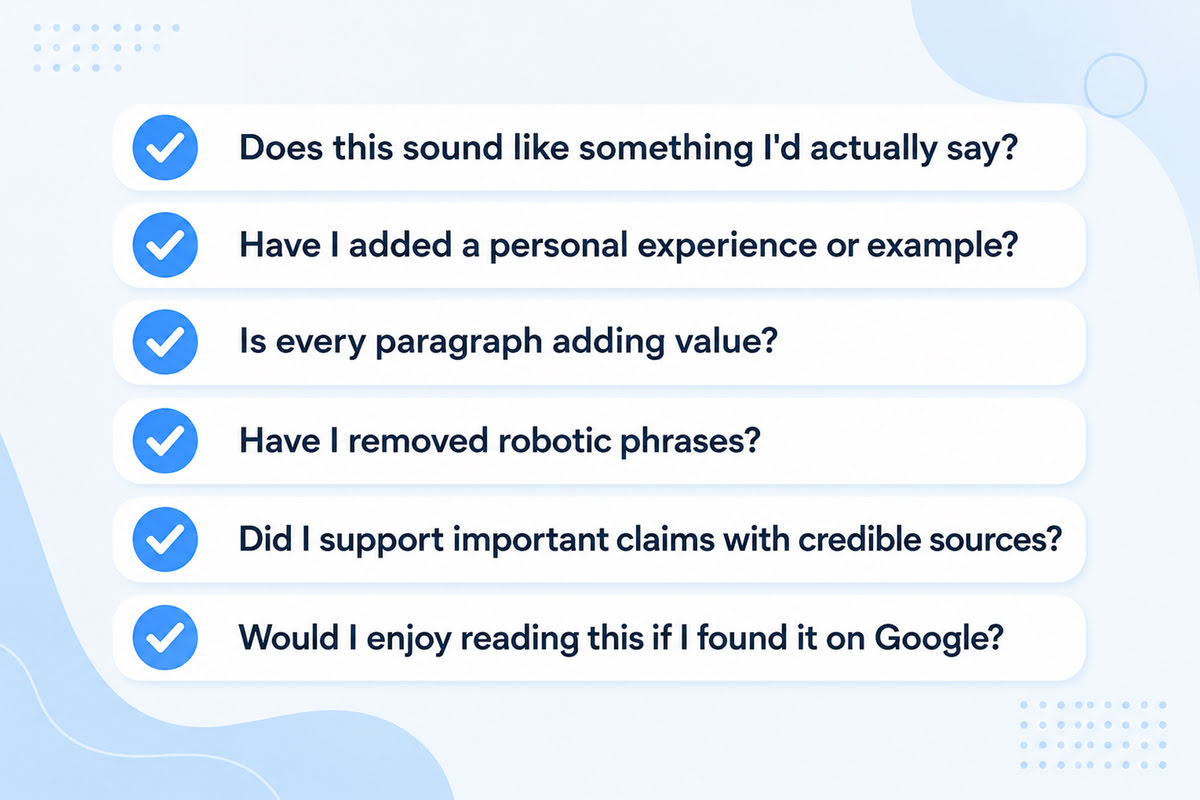
If you answered "yes" to all of the above, you're well on your way to creating content that readers trust and remember.
Need Content That Actually Sounds Human?
If you're a business looking for content that goes beyond keywords and rankings, you're in the right place. At Artx Pro, we provide some of the best SEO content writing services in Pakistan, combining SEO best practices with authentic storytelling, real expertise, and Google's E-E-A-T principles.
From blog posts and website copy to E-E-A-T-focused content, our goal is simple: create content that doesn't just rank; it builds trust, engages your audience, and drives results.
Ready to give your brand a more human voice? Get in touch with Artx Pro today, and let's create content your audience will remember.
Frequently Asked Questions (FAQs)
What is humanized content?
Humanized content combines AI with real experiences, opinions, storytelling, and a natural writing style to make it more authentic and engaging.
What is Google's E-E-A-T?
E-E-A-T stands for Experience, Expertise, Authoritativeness, and Trustworthiness. It's a framework Google uses to evaluate content quality.
Is AI-generated content bad for SEO?
Not necessarily. Google rewards helpful, high-quality content regardless of how it's created. The key is to edit AI-generated content so it provides genuine value.
What are the best AI content writing practices?
Use AI for drafting, then add human insights, originality, and E-E-A-T.
Does Google prefer human-written content or AI-written content?
No. Google rewards helpful, high-quality content, whether it's AI- or human-written.
References
1. Google Search Central. Creating Helpful, Reliable, People-First Content. Google Developers.
2. Google Search Central. Google Search's Guidance on Using Generative AI Content on Your Website. Google Developers.
3. Google Search Quality Evaluator Guidelines. Google Search Central. (Official guidelines explaining E-E-A-T and quality evaluation.)
4. HubSpot. E-E-A-T: Definitions, FAQs & How HubSpot Helps.
Digital Marketing Specialist
With a solid 12+ year background in digital marketing, Danyal delivers blogs packed with timely insights, useful tips, and impactful stories. His writing style is engaging, informative, and always rooted in real-world value for businesses and readers. From breaking down SEO strategies to exploring ecommerce trends and keeping tabs on what’s going viral online, he keeps it fresh, fun, and totally binge-worthy. If it’s worth knowing in the digital world, Danyal’s already writing about it.

An award-winning digital marketing agency dedicated to delivering effective solutions that ensure your success in the age of digital channels, screens, and trends.